
Pignola Genealogy
Tracing your Italian roots back to Pignola (in Potenza province, Basilicata region) begins with understanding which records exist and where they are preserved. On this page you’ll find a clear guide to the historical sources as birth, marriage and death civil and religious records available for family history in Pignola.
Pignola family history at a glance
- Region: Basilicata
- Province: Potenza
- Type of records: civil and parish records
- Civil registration: from 1809 onwards
- Parish records: often older than civil records (in some cases from the 1600s)
How to research your ancestry in Pignola
Thanks to its network of local experts, Italianside has developed significant experience in genealogical research in the province of Potenza. For this reason, over the years it has become a reliable reference for those wishing to reconnect with their Italian roots and could be a key partner in the success of your research too. You can read the feedbacks of our customers on our testimonials page
Our experts in Basilicata region, conducted genealogy research on historical families from Pignola, involving many surnames traditionally found in the town, including branches of the following families: Rosa, Scavone, Lauria, Vignola, Dolce, Albano, Falce, Marino, Paciello, Santarsiero, Mancino, De Stefano, Santangelo, Roma and others.
Many info relating to families and individuals available in public and private local archives include, in addition to names and dates, further information such as occupations, the address where family lived (a great info if you plan to visit Pignola), and key social relationships within the community in past centuries.
The information in genealogy research derives from the archives available for on-site research in Pignola and Basilicata. During the previous activities, our local genealogists developed studies, family trees, cross-referenced family relationships, occupational histories, deciphered or translated documents, residential patterns, and visual documentation useful to add information now forgotten to the history of your family.
Research activities may include all major sources available at municipal, provincial, and regional level:
• civil records
• parish registers
• notarial archives
• military records
• historical and photographic sources available in private archives
Direct access to local archives and a deep understanding of the local context allow for more complete and accurate results. Research may be carried out using all available sources in both public and private archives.
Italian family history research: Beyond Names and Dates
Italian genealogy is deeply local. It can’t be reduced only about collecting birth and death dates.
In Basilicata, every municipality — including Pignola — has its own archival history, record‑keeping traditions, and unique documentary sources. This is why Italianside is able to help you in your Italian ancestry research, through a national network of local experts, each specialized in the archives of their specific territory.
Our researcher who works in Pignola and in the Province of Potenza will be of help to navigate local civil, parish, military, and notarial records, uncovering details that go far beyond basic dates. By combining national coordination and methodology with deep local expertise, our researcher will bring your ancestors’ stories back to life within the history of the Pignola community.
Civil Records (Stato Civile) in Pignola
In towns and villages of Basilicata and in Potenza province, civil registration offices were established in 1809. This means you can often find your ancestors’ civil records in the Town Hall archives of Pignola from that year onwards.
(If your goal is to obtain Italian citizenship and you need official certificates from Pignola, please follow this link.)
If your ancestors lived in Pignola during the past centuries, the City Office of Pignola is usually the first place to start your family research. Our local expert can access these records on your behalf and interpret them correctly.
- Professions: discover what your ancestors did for a living.
- Addresses: find the street or house where the family lived in Pignola.
- Family links: identify parents, witnesses and neighbours that appear in the records.
- Signatures and notes: see how your ancestors signed and read any marginal annotations.
If you prefer to contact the Town Hall by yourself, we suggest reading our genealogy tips for Italy. They include practical advice for research in Basilicata and specifically in Pignola.
Population trends in Pignola
The chart below shows the demographic trends in Pignola from the Italian Unification (1861). Understanding how many people lived in the town over time is useful when interpreting migration and family movements.

Church Records in Pignola
Church archives in Potenza province often preserve information that predates civil records. Parish registers include baptisms, marriages and burials and sometimes allow you to push your family tree back into the 1700s and 1600s.
In many areas of Basilicata, parish registers began around the 1500s. These manuscripts are not easy to access from abroad and can be hard to read without specific training.
Our local genealogists, graduated in history and archival studies, can consult the parish archives of Pignola on your behalf and reconstruct your family history through the centuries.
In case you want to visit churches, these are the addresses of parishes active today in Pignola:
S. MARIA MAGGIORE – Via Dante, 23
Notary records and other historical sources
Another important source of information is represented by notary documents, which preserve wills, dowries, property sales and contracts. These records are usually kept in provincial and State Archives and can provide valuable details on the social and economic life of your family.
Historical and photographic sources available in private archives
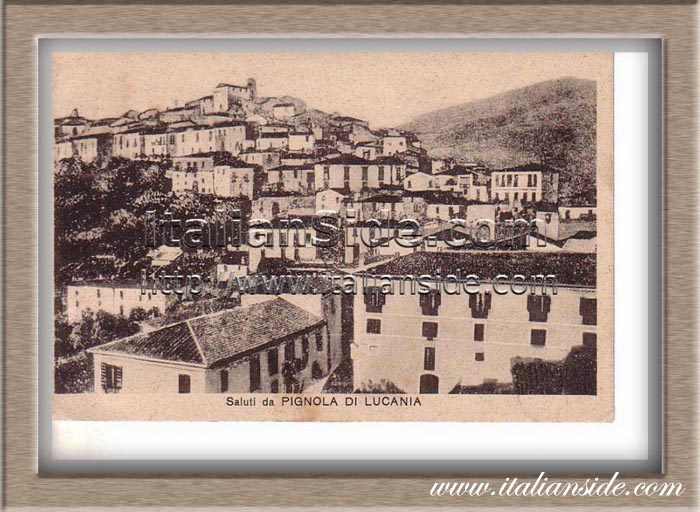
Historical photographs, prints, and documents from private collections—including ItalianSide’s archive of vintage images from Pignola and Basilicata region are available. Old pictures add significant value to your family history research and offer a real sense of the places where your ancestors once lived.
Military records
Conscription lists and service records documenting physical descriptions, dates and places of enlistment, units and ranks held, periods of service, military postings, transfers, and movements, often providing detailed insight into an individual’s life beyond civil registration.
Cadastral and property records in Pignola
Historical cadastral and land records used to identify property ownership, track real estate transfers over time, and confirm the historical presence of families within Pignola. ItalianSide provides professional assistance in accessing and interpreting these records, where available.
Planning a visit to Pignola
From our experience, if you plan to visit Pignola we always recommend starting the research months before your arrival. This way you avoid spending your holidays in offices or churches dealing with bureaucracy.
Remember that archives are not open to the general public and officers or priests are not required by law to grant direct access to the records.
With the results collected by our genealogist before your trip, you will have more time to enjoy the town and its surroundings, walking in the footsteps of your ancestors.
Ready to explore Pignola? Discover our travel proposals to Basilicata and Pignola — or to other destinations across Italy. Our itineraries are developed with our trusted tour operator partners and supported by the expertise of our local specialists, who design personalized heritage journeys in the footsteps of your ancestors.
Professional help for research in Pignola
If you need professional support from our local genealogist in the Pignola area, write to pignola@italianside.com or fill the form here. Our expert will study your request and reply with a research plan and a quote tailored to your family history.
Messages from other visitors in Pignola
Here below you can read messages from other visitors in the Pignola forum. If you simply want to discuss genealogy in Pignola with other people, feel free to leave a message.



My Great Grand Father, Antinio Ricco, was born in Pigjola, Potenza in 1868. He married Mary Guissepe Fierro, born 1877. Antonio immigrated to Utica, New York in 1888. Mary Guisseppe Fierro immigrated in 1892. I don’t know anything more about what area in Pignola. I am interested in learning a little bit more about their families and when and where they were married.
Any help is greatly appreciated. Thank you
Anyone related to Pergola’s, Mancinelli’s, Mancino’s???
My great grandfather, Francisco Coiro, was born in Pignola. I don’t know his birth date, but my grandfather, Nicola Coiro, was born there in 1882. He emigrated to New York State in about 1902.
My gr gr grandfather was also named Francisco Coiro and he was born in Pignola. He married Angela Mancini. They had a daughter, Lucia, in 1891. She immigrated to NY in 1912. I believe that she had at least two brothers, Donato and Nicola. Are we looking for the same family?
Dianna, My husband’s Great Grandfather was Donato Coiro from Pignola. He had a brother Nicola. Donato immigrated to Utica, NY in January 1907, and Nicola in June of 1907. So it sounds like you and my husband share a Great, Great Grandfather.
My grandfather was born in Pignola came to Utica as an infant circa 1909. His name was Frank Coria….but that was a butchered spelling of the family name which is rally Coiro.
Hi father’s name was Gerardo.
Lisa,
My great grandfather was Donato Coiro! My mother was named after great grandma Porsia. Who is your husband?? Donato and Porsia had Nicholas, Jerry, Felix, Josephine, Jenny and Theresa. All had children except aunt Jenny and aunt Theresa. I still live in utica.
I am looking for the address to the City Office of Pignola in order to search some (census pre 1900, birth and property) records. If there is an email address too, that would be helpful. Thank you, Danielle
The people I am interested to know about are Marie Petrone and Saverio Olito/e. Thank you!